Sheffield School of Aeronautics Blog

Does Sheffield Have Aviation Memorabilia on Property?

Aviation attracts people for all kinds of reasons: the sound of takeoff, the rhythm of route planning, or the feeling of connection to history. It’s no surprise that aviation memorabilia holds such strong appeal. From collectible badges and safety cards to airplane memorabilia and model cockpits, these items connect people emotionally to the skies.

We’re often asked whether Sheffield School of Aeronautics has its own collection of aviation keepsakes. And while we don’t showcase display cases of aircraft memorabilia, we’re always glad when someone brings up the question because it reflects a genuine love of flight that we share.

Honoring Aviation Without Display Cases

The reason we don’t have memorabilia on-site isn’t because we don’t value history; it’s because our training spaces are fully dedicated to helping students prepare for operational careers in aviation. Our classrooms feature current FAA dispatch materials, not framed posters or aircraft relics,  but what happens in those classrooms is deeply tied to aviation’s legacy.

That legacy lives on in the tools we still use and the procedures we teach. Students work hands-on with real route simulations, METAR decoders, and flight planning techniques grounded in decades of dispatcher experience. These are the building blocks of careers,  and in many ways, they become their own kind of memory.

If you’re curious what that environment looks like, our virtual school tour offers a full walkthrough of how training takes place here. You’ll see the same setting used by thousands of graduates who’ve gone on to work in dispatch centers around the world.

When Keepsakes Happen Naturally

Though we don’t offer plane souvenirs or branded items, students often find their own meaningful ways to mark their training. A first signed flight release. A worn sector chart. A certificate framed on the wall back home. These might not count as aviation relics to collectors,  but to the person who earned them, they represent something far more personal. That’s the real value of aviation memorabilia: not just preserving old parts, but honoring the experiences that come from working in aviation.

For those looking to gift something special to an aviation student or enthusiast, we’ve shared several creative ideas in our post on aviation-themed gifts. Whether it’s a piece of historic aircraft skin or a handmade logbook cover, these items often mean the most when they support the journey ahead.

Aviation Legacy, Preserved in Purpose

Being an airline dispatcher isn’t just about reading weather charts, it’s about becoming part of a long-standing system of safety, communication, and teamwork. And becoming an aircraft dispatcher means you’re helping shape the movement of flights every day. That kind of responsibility connects students to aviation in a way that’s much deeper than collecting items.

As the longest-running airline dispatcher school in continuous operation, we’ve trained professionals who now work across the globe; many of whom still share stories, photos, or insights back with us. We keep that community going through our aviation blog, where we cover topics ranging from industry trends to weather decision-making.

We also offer a wide selection of FAA-approved courses and schedules through our online catalog, whether you’re pursuing full certification or exploring a refresher option through online dispatcher training. Our aircraft dispatcher training programs are designed to reflect real standards, giving students the tools they’ll use from day one in the field.

For the Collectors, the Curious, and the Career-Bound

Aviation memorabilia is about more than collecting objects,  it’s about holding on to what inspires us. For some, that’s a vintage nameplate or a set of old wings. For others, it’s the first time they’ve helped a delayed aircraft get rerouted safely through a storm. We believe both have value.

Whether you’re someone who treasures airplane souvenirs or you’re hoping to build a future in operations, Sheffield is here to support your path forward. Our FAQs cover many of the questions we get from prospective students that include details about housing, timelines, and career options. You can explore those any time on our FAQ page.

And if you’re ready to take the next step? You don’t need a relic to prove your passion. You just need a place to start.

Contact us today to schedule a visit or enroll in online dispatcher training. At Sheffield School of Aeronautics, we don’t collect the past, we help people move confidently into aviation’s future.


Related Readings: 

Posted in Aviation History, Blog | Comments closed
How to Check Flight Conditions: Best Tools, Apps, and What They Actually Tell You

a map of the US with severe weather patterns

In today’s fast-paced aviation world, flight conditions can change in an instant. Thunderstorms, shifting airspace priorities, or airport congestion can lead to wide-scale delays, even when your departure city looks sunny. A thunderstorm in Atlanta can ripple across multiple airports, causing missed connections in New York and diversions in Florida, all due to evolving flight conditions.

At Sheffield School of Aeronautics, we train future dispatchers to interpret these kinds of real-time changes before they disrupt an entire flight schedule. Understanding flight conditions, whether it’s flight weather or broader flights canceled due to weather, is a vital skill for travelers and aviation professionals alike.

What Are Flight Conditions and Why Do They Matter?

Flight conditions refer to a combination of weather data, airport operations, airspace congestion, and traffic flow at a given moment. Pilots, dispatchers, and ATC rely on this data to make decisions in real time.

Professionals monitor tools like METARs (Meteorological Aerodrome Reports) and TAFs (Terminal Aerodrome Forecasts) to assess visibility, wind, and turbulence risk. The NOAA Aviation Weather Center and FAA NAS Status Page provide timely updates on current and expected flight conditions today and flight conditions tomorrow, including aviation system delays and weather forecasts across the airspace system.

What Causes Flight Delays or Cancellations?

Severe weather like thunderstorms, lightning, or crosswinds, along with low visibility and airport equipment failures, are among the most common causes of flight delays. These disruptions often create a chain reaction through multiple hubs, similar to the patterns outlined in different types of flight delays, where a single issue can cascade across an entire system.

Aviation professionals use tools like EDCT (Expect Departure Clearance Times), ground delay programs, and traffic flow advisories. While travelers might only receive basic status alerts for departure or arrival, dispatchers work behind the scenes to interpret detailed information about what’s due to impact an airline’s route. 

5 Tools That Let You Check Flight Conditions in Real-Time

Official Government Tools

FAA ATCSCC Delay Map
This interactive map from the FAA provides real-time information on air traffic delays across the U.S., helping travelers anticipate potential disruptions.

NOAA Aviation Weather Center
NOAA offers comprehensive aviation weather data, including METARs, TAFs, and turbulence forecasts, essential for flight planning. 

Independent Real-Time Tracking Apps

FlightAware
Track commercial and private flights worldwide with real-time updates on flight status and live maps.
Visit Site | iOS App | Android App

FlightStats
Provides up-to-date flight status, airport conditions, and historical data to help manage travel plans effectively.
Visit Site | iOS App | Android App

MyRadar
Delivers high-definition weather radar with aviation layers, allowing users to monitor weather patterns affecting flights.
Visit Site | iOS App | Android App

Airline Mobile Apps
Most airlines offer their own apps, providing the latest gate changes, boarding times, and real-time flight status. They’re available on the App Store and Google Play, just search for your airline’s official app.

Understanding the Data These Apps Provide

Many apps rely on raw aviation data like METARs and TAFs, which summarize current airport conditions and forecasts. METARs provide minute-by-minute observations, while TAFs predict conditions over 24–30 hour periods.

You might also encounter NOTAMs (Notices to Air Missions), delay codes, reroute announcements, or route congestion indicators. Use these to see how your track, times, or arrival could be impacted. For more details, refer to the FAA METAR/TAF Glossary.

Why Flight Conditions Are Core to Dispatcher Training

Flight dispatchers are trained to read radar, anticipate flight weather, and make fast operational decisions. They monitor the same systems travelers use but through professional software layered with enhanced traffic flow insights and route modeling.

Sheffield School of Aeronautics is the world’s most experienced FAA-approved dispatcher school, in continuous operation since 1948. Our curriculum teaches students to interpret complex flight data and forecast issues before they happen, a critical part of modern aviation operations and a cornerstone of high-quality dispatcher training.

Learn to Read Flight Conditions Like a Pro

Flight planning also accounts for how weather impacts aircraft performance. Questions like if rain cancels flights or if planes can fly in snow are part of standard dispatcher assessments, with answers depending on factors like visibility, runway condition, and aircraft category.

Call Us Today!

Contact us today or call us at 954-581-6022 to begin your journey toward a career in flight operations or airline dispatch.

Explore our online dispatcher training or see what’s possible on our aviation careers landing page.


Sources:

  1. Federal Aviation Administration. (n.d.). ATCSCC Operational Status. https://nasstatus.faa.gov/
  2. Federal Aviation Administration. (2024). Pilot/Controller Glossary. https://www.faa.gov/air_traffic/publications/atpubs/pcg_html/ 
  3. NOAA Aviation Weather Center. (n.d.). Aviation Weather Center. https://aviationweather.gov/
  4. FlightAware. (n.d.). FlightAware: Flight Tracker. https://flightaware.com/
  5. FlightStats. (n.d.). FlightStats by Cirium. https://www.flightstats.com/
  6. MyRadar. (n.d.). MyRadar Weather Radar App. https://myradar.com/

Related Readings: 

Posted in Aviation, Blog | Comments closed
How to Leverage Aviation Trade Shows Networking for Career Growth

Why Aviation Trade Shows Matter for Your Career

A networking convention

In the aviation industry, networking is one of the most important factors in career advancement. Aviation trade shows networking events open doors to job opportunities, professional development, and long-term industry connections. These events bring together aviation professionals, recruiters, and key industry players, providing direct access to hiring managers and decision-makers.

At Sheffield School of Aeronautics, we understand the critical role that aviation trade shows networking plays in career growth. Our programs equip students with the skills and knowledge needed to navigate networking events, connect with aviation professionals, and take full advantage of trade shows for career opportunities.

Why Aviation Trade Shows Are Essential for Career Growth & Industry Connections

The Power of Networking in the Aviation Industry

Building meaningful professional relationships goes beyond merely exchanging business cards; it’s about fostering long-term connections. Studies show that 70% of aviation job placements occur through networking (Boeing). Aviation trade shows networking provides a unique space where professionals, recruiters, and industry leaders converge, making it easier to establish connections that can lead to new career opportunities.

Aviation Trade Shows & Career Advancement: What the Data Says

The Federal Aviation Administration (FAA) actively supports career development programs for aviation professionals, emphasizing the value of industry events for skill-building and employment. Additionally, in 2024, Boeing’s Commercial Market Outlook forecasts a growing demand for aviation professionals, reinforcing the need for networking events to stay ahead of industry trends.

Notable aviation trade shows worth attending include the National Business Aviation Association (NBAA) Convention, Farnborough Airshow, EAA AirVenture Oshkosh, and ICAO Aviation Conferences.

Expert Strategies for Networking Success at Aviation Trade Shows

Setting Clear Goals for Maximum Trade Show Impact

To make the most of a trade show, define clear objectives; whether it’s finding job placement opportunities, forming partnerships, or staying updated on industry advancements. According to FAA career resources, aviation professionals benefit the most from trade shows when they attend industry workshops and participate in networking panels.

Proven Networking Techniques for Aviation Professionals

Effective networking requires strategy. Here’s how to maximize engagement at aviation trade shows networking. Start meaningful conversations by preparing a concise introduction and showing genuine interest in others’ work. Optimize your LinkedIn profile before attending a trade show to ensure your skills and experience are well-represented to potential employers. Follow up professionally after career fairs and networking events since 80% of professionals fail to follow up, making this critical. Engage with hiring managers who attend trade shows to scout talent, as they prioritize candidates who demonstrate knowledge of industry trends and technologies.

Aviation Trade Show Best Practices: Do’s & Don’ts

Do’s – Maximize Your Networking Opportunities

  • Build relationships before, during, and after networking events to cultivate lasting connections.
  • Prepare an elevator pitch to effectively introduce your career goals.
  • Engage in discussions at panels, workshops, and receptions to gain industry insights.
  • Utilize digital networking tools that trade shows provide to connect with professionals.

Don’ts – Common Networking Mistakes to Avoid

  • Networking isn’t just about collecting business cards, focus on quality connections.
  • Avoid only speaking to exhibitors, connect with fellow attendees and professionals.
  • Don’t ignore digital networking opportunities, virtual events are becoming more valuable.

How Sheffield School of Aeronautics Helps Aviation Professionals Network & Advance Their Careers

Why Professional Training Is Key for Effective Aviation Networking

At Sheffield School of Aeronautics, we ensure that students are fully prepared to take advantage of aviation trade shows networking. Our training programs provide industry-specific guidance tailored for aircraft dispatchers, airline professionals, and those seeking leadership roles in aviation.

The FAA’s Workforce Development Program further supports aviation career growth, aligning with our mission to prepare aviation professionals for real-world industry connections.

Sheffield’s Industry Partnerships & Career Placement Support

Sheffield School of Aeronautics connects students directly with aviation employers, recruiters, and aviation industry events to enhance job placement prospects. Our alumni have successfully leveraged aviation trade shows networking to advance their careers, reflecting the strength of our career preparation programs.

We offer both online dispatcher training and in-person courses, ensuring continued education and networking opportunities beyond the classroom.

Final Takeaways: How to Turn Aviation Trade Shows Into Career Opportunities

To fully capitalize on aviation trade shows networking, be proactive, and engage in networking events to build meaningful professional relationships. Stay informed by attending industry events to remain updated on trends and technologies. Use professional training resources like Sheffield School of Aeronautics to enhance networking effectiveness.

Your Next Steps in Aviation Networking

Navigating aviation trade shows networking effectively requires strategy, preparation, and the right training. Whether you’re an aspiring aircraft dispatcher, a seasoned aviation professional, or looking to transition into a new role, networking events provide direct access to hiring managers, industry leaders, and business opportunities.

At Sheffield School of Aeronautics, we provide comprehensive training by our airline dispatcher school designed to help you get ready for your future career. With our online dispatcher training and industry partnerships, we ensure that students are equipped with the knowledge and connections to thrive in the aviation field.

Contact us today to learn how we can help you maximize your aviation career through professional networking opportunities and career development resources.


References

Boeing: Pilot and Technician Outlook – Boeing
Retrieved from: https://www.boeing.com/commercial/market/pilot-technician-outlook

FAA: Career Growth and Development – Federal Aviation Administration (FAA)
Retrieved from: https://www.faa.gov/jobs/working_here/career_growth_development

Boeing: Commercial Market Outlook – Boeing
Retrieved from: https://www.boeing.com/commercial/market/commercial-market-outlook

FAA: Aviation Workforce Development Grants – Federal Aviation Administration (FAA)
Retrieved from: https://www.faa.gov/about/office_org/headquarters_offices/ang/grants/awd

Posted in Aircraft Dispatch Education & Advice, Aircraft Dispatcher School, Becoming an Aircraft Dispatcher | Comments closed
AI and Aviation Technology in Flight Dispatch

How AI Is Reshaping Technology in Flight Dispatch

A flight dispatcher using AI

Imagine this: you’re an aircraft dispatcher, responsible for planning flight paths, adjusting for weather conditions, and coordinating with pilots and air traffic to keep flights running smoothly. Now, add artificial intelligence to the equation. Suddenly, aviation software tools are analyzing real-time updates, predicting delays, and even suggesting ways to reduce fuel consumption.

This isn’t the future, it’s happening now. AI is driving massive changes with technology in flight dispatch. This is changing flight planning software: it’s improving the safety and efficiency of flight while transforming the role of airline dispatchers. At Sheffield School of Aeronautics, we’re staying ahead of these advancements to make sure our students are prepared to integrate AI-driven aviation systems into their careers.

The Role of AI in Flight Dispatch Operations

AI has become a game-changer in aviation operations, helping dispatchers make faster, smarter decisions. The FAA’s AI Roadmap highlights how AI is improving aviation safety, optimizing ground operations, and revolutionizing flight training.

How AI Algorithms Improve Dispatch Automation

AI-powered dispatch automation has redefined the way flights are planned. These systems:

  • Analyze flight paths based on real-time weather and air traffic control data.
  • Enhance safety by identifying risks before they become issues.
  • Integrate AI technologies into aviation software tools for improved efficiency.

AI-Driven Software and Digital Flight Planning

Why AI Is Changing Digital Flight Planning

The aviation industry is experiencing rapid change with AI-powered aviation dispatch software. Machine learning models help dispatchers:

  • Reduce fuel consumption through optimized routes.
  • Enhance maintenance operations, preventing costly delays.
  • Use biometric technology for secure system access.

The impact of AI on digital flight planning is both operational and financial. According to IATA, airlines using AI in flight planning have reduced costs by 4.4%, improving efficiency while lowering flight prices.

Route Optimization and AI-Powered Air Traffic Management

How AI Enhances Safety & Route Planning

AI’s ability to optimize flight paths means pilots and air traffic control teams can react to real-time updates more effectively. For example, Alaska Airlines used AI-driven route optimization, cutting fuel consumption and preventing 6,800 metric tons of CO₂ emissions in one year.

AI also strengthens aviation safety agency efforts by:

  • Supporting air traffic controllers with data-driven decision-making.
  • Integrating AI algorithms to adjust routes instantly.
  • Improving flight operations officers’ ability to predict potential delays.

The Growing Demand for AI-Integrated Flight Dispatch Training

Why Training Matters for the Future of Dispatchers

The integration of more AI and software in aviation is no longer optional for airline dispatchers, it’s becoming a requirement. Future dispatchers must understand aviation technology, machine learning algorithms, and AI’s impact on aviation operations. That’s why Sheffield School of Aeronautics is ensuring its curriculum evolves alongside industry changes.

How Sheffield School of Aeronautics Prepares You

At Sheffield School of Aeronautics, we integrate flight options that reflect real-world scenarios, using AI-enhanced tools to help students master:

  • AI in aviation, including AI-driven flight planning software.
  • Aviation safety practices using predictive analytics.
  • Complete flight operations, from including dispatch logistics to maintenance operations.

Take the Next Step in AI-Integrated Dispatch Training

AI is transforming technology in flight dispatch, revolutionizing how an airline dispatcher would plan, manage, and optimize flights. The ability to analyze air traffic, adjust flight schedules, and make data-driven decisions is no longer a future possibility, it’s the industry standard.

At Sheffield School of Aeronautics, we are committed to training dispatchers who are ready to integrate AI in aviation. Our courses reflect the latest advancements in aviation dispatch software, aviation systems, and aviation software tools.

If you’re serious about a career in aircraft dispatch, now is the time to prepare. Contact us today to learn more about our airline dispatcher school and how AI-powered training can advance your in-person and online dispatcher training future in aviation.


References

  1. FAA: Roadmap for Artificial Intelligence Safety Assurance Federal Aviation Administration (FAA)
    Retrieved from: https://www.faa.gov/aircraft/air_cert/step/roadmap_for_AI_safety_assurance

  2. IATA Expands Operational Data Analytics Capabilities International Air Transport Association (IATA)
    Retrieved from: https://www.iata.org/en/pressroom/2023-releases/2023-12-07-01/

  3. AI: How It’s Delivering Sharper Route Planning Aerospace America
    Retrieved from: https://aerospaceamerica.aiaa.org/features/ai-how-its-delivering-sharper-route-planning/

  4. AI in Aviation: Future Trends and Implementations International Air Transport Association (IATA)
    Retrieved from: https://www.iata.org/contentassets/2d997082f3c84c7cba001f506edd2c2e/ai-white-paper.pdf

  5. Data and AI in Aviation: 2025 and Beyond International Air Transport Association (IATA)
    Retrieved from: https://www.iata.org/contentassets/a46387f9bc6b42368c0a72664f6f930f/data-tech-poc-2025.pdf
Posted in Aircraft Dispatch Education & Advice, Aviation, News & Regulations | Comments closed
U.S. Agent Information for FAA Aircraft Dispatcher Certificate seekers and Certificate holders

Updated July 1, 2025

The FAA recently made a change to regulation requiring all certificated airmen without a permanent mailing address in the United States to designate an “agent for service.”  The agent for service is a person or company that can receive official, urgent notifications from the FAA and then relay that information to you.

If you have a family member or good friend who lives within the United States who agrees to take on this responsibility for you, then you may list that person as your agent. If there’s nobody in the United States that you know who can do this for you, there are companies available that will provide that service for a fee. The links for two such companies are below:

We do not endorse any particular company; we just know that they have already reached out to some of our graduates outside the USA to offer their services.

Also, please note that Sheffield School will not be able to act as an agent for service.

Once you have determined who you’d like to designate as your agent for service, then you will need to designate that person with the FAA on your behalf. The FAA has created a web portal for that purpose.  The deadline for a current certificate holder to register your agent for service to the FAA in the portal is July 7. Here’s that link:

https://usas.faa.gov

Also, please note the following with minor paraphrasing:

“not being able to exercise privileges” until you designate an agent is not “your certificate will be revoked if you don’t designate, and recertification is required.” If I’m wrong, then they need better authors. Below is their wording; however, I recommend following their directions.
“No individual shall exercise the privileges of any certificate, rating, or authorization issued under part 47, 61, 63, 65, 67, or 107 of this chapter unless the individual has designated a U.S. agent as required under this subpart…
 

To summarize:
This exercise is mostly for notices of suspension or revocation, which is essentially unheard of for airmen outside the USA. By default, nobody is exercising the privileges of their certificate outside the USA. I question this requirement along with all these companies charging $50-100 annually to likely do nothing for you. In my 46 years of multiple FAA certifications, I’ve never heard from the FAA, except for being mailed a certificate. Make sure these “Agents” send you your FAA certificates if you’ve designated them to do so. If it takes over 2 months, something is not right.

Best Regards,

Eric Morris
President
Sheffield School of Aeronautics (est. 1948) – www.sheffield.com

Posted in News & Regulations | Comments closed
How High Do Airplanes Go?

A commercial airplane with red and white accents ascending into the sky, representing aircraft altitude. The Sheffield School of Aeronautics logo is visible in the top left corner.

Many air travelers wonder, “How high do airplanes go?” Whether you’re a frequent flyer or just curious about the science behind aviation, understanding altitude levels can help demystify the experience of flying. Different aircraft fly at different heights depending on factors such as flight distance, fuel efficiency, and safety regulations.

At Sheffield School of Aeronautics, we specialize in flight dispatch training and understand the intricacies of commercial aviation. In this guide, we’ll explore the maximum altitude for commercial airplanes, the concept of cruising altitude, and why planes fly at high altitudes.

Understanding Airplane Altitudes

Aircraft operate at various altitudes depending on multiple factors. During takeoff, planes travel through lower airspace. Once they reach cruising altitude, they maintain a steady flight path for most of the journey. The maximum altitude, known as the service ceiling, represents the highest safe limit for commercial aircraft. Each of these altitude levels plays a role in ensuring efficiency and safety for passengers and crew. But how high do commercial aircraft typically go?

Max Altitude for Commercial Airplanes

The maximum altitude for commercial airplanes is generally 42,000 feet, a limit known as the service ceiling. This altitude is determined by factors such as engine performance, air pressure, and oxygen availability.

While commercial jets have an upper limit of 42,000 feet, most flights operate slightly lower, with cruising altitudes ranging between 30,000 and 40,000 feet. This range provides optimal fuel efficiency and ensures a smoother flight experience for passengers.

Why don’t planes fly higher? At extreme altitudes, the air becomes too thin for standard jet engines to function efficiently. Cabin pressurization is also a critical concern, as passengers and crew require stable oxygen levels to remain comfortable and safe.

Why Do Planes Fly at High Altitudes?

Flying at higher altitudes offers several key advantages for commercial aviation.

Fuel Efficiency and Performance

At higher altitudes, the air is thinner, reducing resistance against the aircraft. This allows planes to travel faster while using less fuel, which improves overall efficiency and reduces costs for airlines.

Smoother Flights

Most weather disturbances, such as turbulence caused by storms and jet streams, occur at lower altitudes. By flying between 30,000 and 40,000 feet, airplanes can avoid many of these disruptions, resulting in a more comfortable experience for passengers.

Time Optimization

Commercial airlines operate on strict schedules. By flying at higher altitudes, they can avoid lower-altitude air traffic, ensuring more efficient routing and minimizing delays.

What Determines a Plane’s Cruising Altitude?

Although the standard cruising altitude for commercial planes falls between 30,000 and 40,000 feet, several factors influence this choice. Flight distance plays a major role. Short-haul flights often cruise at lower altitudes because they do not travel long enough to reach peak altitude before beginning the descent. In contrast, long-haul flights ascend higher to maximize fuel efficiency. Aircraft size and weight also contribute, as heavier planes may require altitude adjustments compared to smaller aircraft. Additionally, air traffic controllers regulate altitude assignments to ensure safe separation and avoid congestion, and adverse weather conditions may require changes to cruising levels.

Are There Risks to Flying Too High?

Planes cannot exceed their service ceiling due to safety and mechanical limitations. If an aircraft were to fly too high, several issues could arise. The air becomes too thin to generate sufficient thrust, leading to reduced engine performance. Cabin pressurization must be maintained to ensure oxygen levels remain safe for passengers and crew. Additionally, planes are designed to withstand specific pressure differences, and exceeding altitude limits could compromise their structural integrity.

How High Do Other Aircraft Fly?

Not all aircraft operate within the same altitude range. Military aircraft, such as some fighter jets, can exceed 50,000 feet, thanks to advanced engine technology. Private jets often fly higher than commercial airliners, sometimes reaching 45,000 feet, to avoid congestion and turbulence. Helicopters, on the other hand, operate at much lower altitudes, typically staying below 10,000 feet due to their unique design and purpose.

Sheffield School of Aeronautics: Your Path to Flight Dispatching

At Sheffield School of Aeronautics, we specialize in training the next generation of FAA-certified flight dispatchers. Whether you’re interested in airline flight planning, international dispatching, or private aviation logistics, our expert-led courses provide the knowledge and skills you need for a successful career in aviation.

If you’ve ever asked, “How high do airplanes go?” we hope this guide has provided the answers! If you’re looking for a rewarding career in aviation, contact Sheffield School of Aeronautics today to learn more about our industry-leading flight dispatch training programs.

Posted in Aviation, Travel | Tagged , , , , , | Comments closed
Do Airplanes Fly Directly Over the Pacific Ocean? 

A clear blue sky is seen above serene ocean waters.

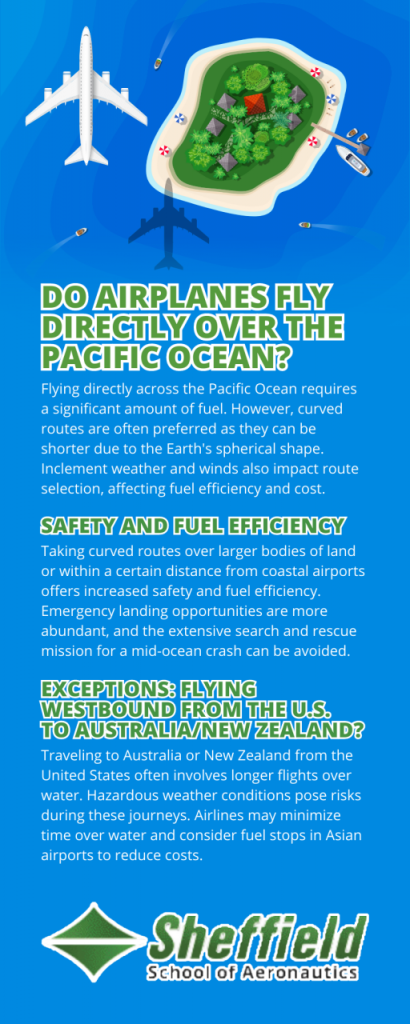
Anyone who has traveled to locations in the Pacific knows that there are very few flights that fly over the entire ocean. Rather, they choose curved routes that fly over larger bodies of land. If you are interested in becoming a flight dispatcher, you are most likely curious about the best way to plan a flight from one end of the Pacific Ocean to the other. In the following article, Sheffield School of Aeronautics, an experienced flight dispatcher school, will detail some of the reasons why you will need special consideration when planning a flight of this caliber. Do airplanes fly over the Pacific Ocean? Continue reading below for more information. 

Why Don’t Some Airplanes Fly Over the Pacific Ocean? 

The Pacific Ocean is a massive body of water that will require an extremely large amount of fuel to fly across. Rather than flying directly across the Pacific Ocean, most commercial flights take curved routes because they are actually shorter than shooting straight across a distance. A curved flight may sound counterintuitive, but since the Earth is spherical, a straight line is not necessarily the shortest distance between two points. Inclement weather and winds may also affect selected minimum-cost routes.

Another reason that airplanes may choose to take curved routes is that they are safer and more fuel-efficient than a straight line. By taking a curved path that covers more land than a straight line or by taking a route within usually 2 to 3 hours from a coastal airport (one form of Extended Range Operations – ETOPS), there will be more opportunities for emergency landings should there be a need for one. Lastly, if an airplane were to, unfortunately, crash in the middle of the Pacific Ocean, it would take an extremely extensive search and rescue mission to find the aircraft

Regulatory Considerations for Transpacific Flights

When planning flights over the Pacific Ocean, airlines must adhere to specific regulatory requirements to ensure safety and operational efficiency. The Federal Aviation Administration (FAA) provides comprehensive guidelines for operations in oceanic and remote continental airspace, as detailed in their Advisory Circular AC 91-70B.1

This document outlines necessary authorizations, equipment standards, and operational procedures for extended flights over vast oceanic regions. Key considerations include compliance with Performance-Based Navigation (PBN) specifications and adherence to communication protocols in areas with limited radar coverage. Understanding and implementing these regulations are crucial for flight dispatchers to plan safe and compliant transpacific routes.

Some Exceptions: Flying Westbound from the U.S. to Australia/New Zealand? 

Australia is one of the most popular locations for people flying across the Pacific. Australia is extremely far from the nearest location in the United States. This distance means that an airplane will spend a longer amount of time flying over water. Hazardous weather conditions and larger weather systems can occur over bodies of water. These include thunderstorms, which are extremely dangerous to flights. So, there can be cases in which airlines may look to spend as little time as possible flying over water or apply ETOPS. Another reason that planes may not fly directly west to Australia is that airlines look to cut fuel costs by taking more fuel stops in airports across the different airports in Asia. Few airplanes could handle a transpacific flight, but a flight of this caliber usually lasts between 11 to 12 hours. 

However, unless a series of factors seriously affect westbound Pacific flights to Australia or New Zealand, etc., airplanes generally fly from the U.S. across the Pacific to Australia because it usually saves time and fuel and is considered safe, especially with modern aircraft. 

Other exceptions include flying over the Pacific when the departure and destination are further north in latitude. This more direct route may reduce distance and/or take advantage of a more favorable overall cruise wind component. For ETOPS flights, en route alternate airport availability may also affect decision-making as well regarding flying across the Pacific.

Technological Advancements in Transpacific Flight Planning

Advancements in aviation technology have significantly improved the safety and efficiency of transpacific flights. Modern aircraft are equipped with sophisticated navigation systems that facilitate precise route planning and real-time adjustments based on weather patterns and air traffic. Additionally, the implementation of Trajectory-Based Operations (TBO) allows for optimized flight paths that reduce fuel consumption and environmental impact. The National Aeronautics and Space Administration (NASA) has been instrumental in developing these technologies, aiming to enhance the predictability and management of oceanic flights.2

For flight dispatchers, staying abreast of these technological developments is essential to leverage tools that enhance operational decision-making and flight safety.

More About Sheffield School of Aeronautics

Interested in a flight dispatch course? Sheffield School of Aeronautics is an experienced airline dispatcher school that is dedicated to helping students and prospective FAA dispatchers with our wide collection of courses and resources. Aside from answering questions like “Do airplanes fly directly over the Pacific Ocean?” we make sure to provide a comprehensive list of everything that a student may need to know. We offer international flight planning and flight weather planning courses, among many others. Contact us today to discover what makes us one of the most sought-after aircraft dispatching schools in the nation.


SOURCE: 

  1. FAA – AC 91-70B – Oceanic and Remote Continental Airspace Operations
  2. NASA – Oceanic Flights and Airspace: Improving Efficiency by Trajectory-Based Operations

RELATED READING:

FAA – Pacific Resource Guide for US Operators 

Posted in Blog, News & Regulations | Tagged , , , , , , , , , , , , , , | Comments closed
Does Rain Cancel Flights?

A piece of glass is covered in rain drops. Through the glass and water, blurred images of items that are green and blue can be seen. It appears the perspective is someone standing inside looking out their window. This relates to the article Does Rain Cancel Flights?

Many people worry when they realize that it is raining on the day of their flight. But does rain cancel flights? They think the rain might delay or even cancel their flight. Rain itself will rarely even delay a flight, let alone cancel it. While the weather is a crucial factor regarding when or if a flight gets canceled, rainy weather is typically not a factor. Our experts at Sheffield School of Aeronautics, a premier flight dispatcher school, are here to give you the rundown on whether you should be worried about your flight being canceled or delayed due to rain. We offer online flight dispatcher courses, FAA and ICAO-sponsored training, and much more. Keep reading to find out more.

Does Rain Affect Flights?

Rain can affect flights in several ways. Heavy rain can reduce visibility, create slippery runway conditions, and necessitate additional safety checks. It can also cause air traffic controllers to space out flights more carefully, leading to delays. While light rain typically has minimal impact, severe weather conditions associated with rain, such as thunderstorms, can significantly disrupt flight operations.

Does Rain Delay Flights?

If you were wondering, “Can rain delay a flight?” the answer is, yes, it can. This mostly happens when it is a heavy downpour, part of a severe weather system, causes poor visibility, or is accompanied by other adverse weather conditions. Rain can also create slippery conditions on runways and taxiways, requiring additional precautions and slower speeds for aircraft.

While rain has a very slim chance of canceling a flight, there can be a minor chance that rain will delay it. Rain is simply water. When it rains, the drops can be of different sizes and fall in varying levels of pressure. Modern aircraft can generate lift regardless of the heaviness of the rain. Planes can and will take off and land in the rain. There is one significant problem with heavy rainfall, which is the decrease in pilot visibility.

But does rain delay flights? Rain is a preface for secondary weather factors. Usually, extra eyes will be on the weather when it rains. This is done just in case the rain turns into something more detrimental.

A flight weather radar will monitor the conditions to ensure everyone is aware of the flight weather report. When sending up planes for flights in rain, air traffic controllers may increase the distance between flights for safety, leading to delays. While light rain usually does not cause major disruptions, severe rain can lead to significant flight delays.

Can Flights Take Off in the Rain?

Yes, flights can take off in the rain. Modern aircraft are built to handle weather conditions, including rain, and pilots are trained to operate safely in these environments. Airports have drainage systems and other infrastructure to manage rainwater and maintain runway conditions. Unless the rain is accompanied by severe weather, such as thunderstorms or heavy winds, flights can typically take off without significant issues.  However, if the rain is accompanied by severe weather, flights may be delayed or rerouted for safety reasons.

Do They Cancel Flights for Rain?

Flights are not typically canceled solely because of rain, as modern aircraft and airports are designed to handle rainy conditions. Though rain alone rarely cancels flights, if the rain is part of a severe weather system with hazards like thunderstorms, lightning, or strong winds, flights may be canceled to avoid risking passenger and crew safety. 

Generally, the temperature of the rain can affect take-off and landing. If it is so cold that the rain turns into hail or snow, a flight could be delayed or canceled. Additionally, if heavy rain causes flooding or significant disruptions at the airport, operations may be significantly impacted, leading to cancellations.

Airlines try not to cancel or delay flights as much as possible. Even one small change in their schedule can have a huge impact on other flights and airports. 

What Type of Weather Delays a Flight?

Weather that delays and cancels flights is called inclement weather. Inclement weather is categorized as thunderstorms, snowstorms, wind shear, icing, and fog. Any inclement weather is by far the most hazardous. This is the type of weather that causes the most cancellations and delays, not just rain. Though there would not be a cancellation simply for rain, if there are thunderstorms, this would be cause for cancellation. Thunder is when things can be more dangerous or start to become tricky.

There are various steps that airlines will go through to determine whether they think there is inclement weather and whether a flight should be delayed or canceled due to it. There are air traffic control centers and airport towers whose primary responsibilities are to gather all the intricate weather information needed hours in advance to predict routes that might be blocked by bad weather. Remember that you are in good hands when an executive decision is made regarding whether or not to cancel a flight due to weather.

More About Sheffield School of Aeronautics

Do flights get delayed for rain? As you have read, this generally isn’t the case. Do they cancel flights for rain? Safety concerns always take precedence. As safety is the top priority, flights will be canceled if conditions are deemed unsafe. But, again, this is only done in extreme circumstances when a cancellation is deemed absolutely necessary.

If you want to learn more about flights, Sheffield School of Aeronautics is an experienced flight dispatcher school. We are here to ensure that our students receive the best training possible for their careers.

At Sheffield, we teach many things about flying beyond whether rain can delay flights. Our classrooms and professors are some of the most cutting-edge available. This translates to our airline dispatcher school, which ensures you can accomplish the aeronautics career that you desire.

Contact us today to learn more about rain and flights, in addition to learning about international flight planning, our flight dispatch courses, or becoming an FAA dispatcher. 


SOURCE:

Federal Aviation Administration – FAQ: Weather Delay

Posted in Aviation, News & Regulations, Travel | Tagged , , , , , , , , , , , , | Comments closed
What Are FAA-Approved Dispatcher Schools?

Are you contemplating becoming a flight dispatcher? If so, you’ve probably heard of the FAA or that you must attend one of the FAA-approved dispatcher schools like Sheffield School of Aeronautics. But what does “FAA” stand for? The abbreviation FAA stands for the Federal Aviation Administration. 

Established in 1958, the Federal Aviation Administration regulates all aspects of civil aviation in the United States. These regulations include air traffic control, aircraft certification, and enforcing safety standards.

To learn more about the FAA, what it does, and information regarding FAA approval for dispatcher schools, continue reading below to find out from Sheffield School of Aeronautics the answers to these questions and more. A large, bronze sign that reads “Department of Transportation Federal Aviation Administration” is in front of a tall, grayish building with many windows. This helps us understand that the blog is related, and it’s called FAA Dispatcher Schools.

What Does the FAA Do?

If you wonder, “What is the Federal Aviation Administration?” or “What does the FAA do?” we have some insight we want to share.

The FAA approves aircraft pilot schools and other aviation-related training programs. This comprehensive oversight ensures consistency and high standards across all aspects of flight training. The FAA’s involvement in regulating these educational institutions began in 1964, under the Federal Aviation Act of 1958, establishing a unified national aviation authority dedicated to maintaining and enhancing safety in the aviation industry.

The dedication to safety by the Federal Aviation Administration is one reason why the FAA approves aircraft pilot schools and other aviation-related training programs. This comprehensive oversight ensures consistency and high standards across all aspects of flight training.

Flight Dispatcher Schools and the FAA

Aircraft dispatcher schools must be FAA-approved to ensure they meet the standards set by the FAA for training and curriculum. To show their competency, these schools must demonstrate that they have qualified instructors, adequate facilities, and an approved training program that meets the FAA’s stringent requirements.

Steps in the FAA Certification Process

The FAA certification process for flight dispatcher schools is rigorous to ensure high training and safety standards. The first step involves submitting a detailed application outlining its curriculum, facilities, instructional methods, and instructor qualifications. The FAA then conducts an initial evaluation to verify that the school meets the basic regulatory requirements. An on-site inspection follows the initial evaluation. FAA representatives review the school’s training equipment, instructional materials, and overall educational environment during this evaluation. 

The school’s instructors are assessed for their qualifications and competency. The curriculum must comprehensively cover all required topics, including aviation regulations, meteorology, navigation, and emergency procedures. Schools must also demonstrate their ability to conduct practical training effectively, ensuring students can apply theoretical knowledge in real-world scenarios. 

After passing these evaluations, the school receives provisional certification, during which the FAA closely monitors its operations. Upon successful completion of this probationary period, the school receives full certification. Continuous compliance with FAA standards is mandatory, and regular audits and inspections are required to maintain certification. 

The FAA’s oversight ensures that programs offering dispatcher training or pilot training produce competent professionals capable of maintaining high safety standards in the aviation industry. This meticulous process ensures that flight dispatcher schools provide top-tier education, preparing students for the critical responsibilities of aircraft dispatching.

Approved schools like Sheffield School of Aeronautics provide comprehensive training to prepare students for the FAA certification process, ensuring they are well-equipped for their roles in the aviation sector.

What Happens When Dispatcher Schools  Aren’t FAA-Approved?

The lack of FAA approval means the school’s training program has not yet proven it meets federal standards, which is crucial for ensuring the quality and safety of the education provided. Dispatcher schools cannot legally open their doors to students before obtaining FAA approval. If a school operates without FAA certification, students will face significant challenges, including being ineligible to receive their FAA flight dispatcher certification.

Consequently, any training received from a non-approved school would not be recognized by the FAA, rendering students unable to sit for their FAA certification exams. FAA certification is mandatory for working as an aircraft dispatcher in the United States. Furthermore, operating without FAA approval can result in legal repercussions for the school, including fines and forced closure. Thus, FAA approval is essential for the institution’s legitimacy and the students’ future careers.

Flight Dispatchers and the FAA

Flight dispatchers play a crucial role in aviation safety. They work closely with pilots to create flight plans, monitor weather conditions, and ensure compliance with regulations. To ensure they have the appropriate knowledge and experience, aircraft dispatchers must obtain FAA certification, which involves passing both a written exam and a practical test. 

Learn From the Best Aircraft Dispatchers in South Florida at Sheffield School of Aeronautics

Contact us online for more insights and professional training in flight dispatching. We are also knowledgeable about many other aviation topics. Read our blogs and benefit from our knowledge about flight planning and dispatch essentials, whether rain can cancel flights, and many others.

You can take the first step toward mastering flight dispatching with Sheffield’s airline dispatcher school.

Posted in Aircraft Dispatcher School, Aviation, FAA | Tagged , , , , , | Comments closed
How Do Airplanes Work?

When you were a child, you probably had many questions about nature that you asked your mom, dad, teachers, or anyone who would listen. Why is the sky blue? How hot is the sun? You might even wonder about man-made products like airplanes. At one time or another, you probably asked someone, “How do airplanes fly?” or even‘“How do airplanes work?”

Airplanes work based on aerodynamics principles, which involve air movement around the aircraft to create lift, thrust, drag, and weight. The wings are designed to generate lift with a curved upper surface and a flatter lower surface. This causes air to move faster over the top than underneath, creating a pressure difference that lifts the plane. The engines provide thrust, propelling the plane forward, while the tail and control surfaces help stabilize and maneuver the aircraft.

To learn more about airplane parts, how they work, and how they fly, continue reading below to find out from the aircraft dispatcher specialists at Sheffield School of Aeronautics.

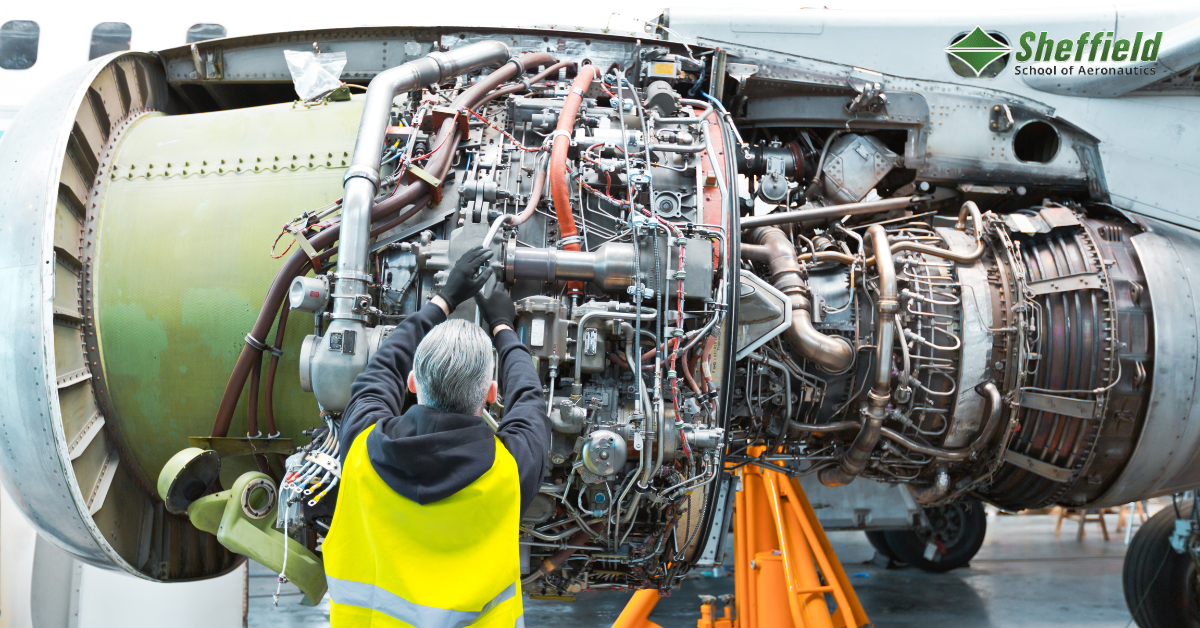
An aircraft mechanic is looking at the inside components of an airplanes wing, indicating that this blog will answer how to airplanes work.

How High Do Airplanes Fly?

You might wonder how high do airplanes go? Commercial airplanes typically fly between 30,000 and 40,000 feet, known as the cruising altitude. This altitude range offers an optimal balance between fuel efficiency and engine performance. At these heights, the air is thinner, which reduces drag and allows the aircraft to travel faster and more efficiently. Flying at high altitudes also helps avoid weather disturbances and turbulence, which are more common at lower levels.

What Are the 5 Basic Parts of an Airplane?

The main parts of an airplane include the fuselage, wings, empennage, landing gear, and engines. Each part has specifi

c components:

  • Fuselage: The main body housing the cockpit, passengers, and cargo.
  • Wings: Generate lift to support the airplane in flight.
  • Empennage: The tail section includes horizontal and vertical stabilizers for stability and control.
  • Landing Gear: Supports the aircraft during takeoff, landing, and taxiing.
  • Powerplant: The engine or engines that provide thrust.

Fuselage

The fuselage, the main body of an airplane, serves as the central structure to which all other components are attached. It houses the cockpit, where pilots control the aircraft and the cabin, accommodating passengers and cargo. Structurally, the fuselage is designed to withstand various aerodynamic forces and stresses during

 flight. It provides a streamlined shape to minimize drag and ensure efficient flight dynamics.

Wings

Before you can answer, “How do the wings of an airplane work?” you need to know about the parts of an airplane wing. These parts include:

  • Spars: The main structural supports running the length of the wing.
  • Ribs: The cross-sectional supports give the wing its shape.
  • Ailerons: Control surfaces on the trailing edge for roll control.
  • Flaps: Extendable surfaces on the trailing edge to increase lift during takeoff and landing.
  • Winglet: Small vertical surfaces at the tips to reduce drag.

These components work harmoniously to ensure the airplane can generate lift, be controlled by the pilot, and safely take off, fly, and land.

An airplane’s wings generate lift by creating a pressure difference between the upper and lower surfaces. The curved upper surface causes air to move faster, reducing pressure above the wing, while the flatter lower surface increases pressure below, lifting the plane.

Empennage

The tail, or empennage, comprises the horizontal stabilizer, vertical stabilizer, rudder, and elevator. This aircraft section is crucial for maintaining stability and control during flight. The horizontal stabilizer prevents unwanted pitch movements, while the vertical stabilizer keeps the aircraft from yawing side to side. The rudder a

nd elevator are movable control surfaces that pilots use to adjust the aircraft’s direction and attitude.

Landing Gear

Landing gear supports the aircraft during takeoff, landing, and taxiing. It consists of wheels, struts, brakes, and shock absorbers. During takeoff and landing, the landing gear absorbs the impact with the runway, ensuring a smooth transition. Modern aircraft often have retractable landing gear, which can be stowed away during flight to reduce drag and improve aerodynamic efficiency. The landing gear also has brakes to help slow down the aircraft upon landing.

Engine/Powerplant

Are you wondering, “How do airplane engines work?” Airplane engines, particularly jet engines, operate on the principle of jet propulsion. It converts fuel into mechanical energy to generate thrust, propelling the aircraft forward. Air is sucked into the engine’s intake and compressed by a series of fan blades. Next, fuel is injected into the compressed air and ignited in the combustion chamber, producing a high-pressure, high-velocity stream of exhaust gasses. These gasses are expelled out of the back of the engine, generating thru

st that propels the airplane forward. The efficiency and power of jet engines make them suitable for the high-speed, long-distance travel that modern aviation requires.

How Do Airplane Propellers Work?

Unlike jet engines, propeller engines use a rotating propeller to create thrust by moving air backward. Airplane propellers convert rotational power into thrust. The propeller’s blades are shaped like airfoils, creating a pressure difference as they spin, pulling the airplane forward through the air. The engine powers the propeller’s rotation, while the angle of the blades (pitch) can be adjusted to optimize performance.

Now That You Know How Airplanes Work Let Sheffield Work for You

So, are you interested in starting an aviation career? If yes, you will likely have much to learn. Now that you can answer, “How do airplanes work?” you are already on your way.

At Sheffield School of Aeronautics, an FAA-approved flight dispatcher school, we teach our students more than how to become an aircraft dispatcher. For information regarding what we know, read our blogs and learn about Air Traffic Controller Qualifications, ADX Test Prep, and other topics related to dispatching or flying.

If you want to learn more about our school, read our About Sheffield page. Then, once you are ready to register at our flight dispatcher school, contact us online today. You can also call us toll-free at 800-843-8289. Let your dispatcher career soar at Sheffield School of Aeronautics.

Posted in Aircraft Dispatcher School, Aviation, Becoming an Aircraft Dispatcher | Tagged , , , , , , | Comments closed
  • Contact Us

    • This field is for validation purposes and should be left unchanged.
  • Testimonials

    “After receiving my certificate, I joined a class of 4 experienced dispatchers for Part 121 initial training. Without experience, my preparation at Sheffield enabled me to become active at the same time after the initial training.” PR PR
    “Sheffield School of Aeronautics is known worldwide for its quality training and has been recommended to me by our national airline Swiss International Airlines. Whenever I mention the name ‘Sheffield’ it rings a bell in people’s ears.” IW IW
    “Their reputation of excellence amongst the industry is second to none. Sheffield School of Aeronautics should be seen as the standard of how it can be done and how it should be done. I was hired at a major airline with no dispatch experience.” A.Z. Sidebar AZ
    “Being that half my new hire class dropped out over the course of training, I can confidently say that Sheffield helped to prepare me for the real world.” GT – abridged testimonial – school selection matters
    “As a graduate of Sheffield School of Aeronautics I am a firm believer that I received the most thorough and well thought out aircraft dispatcher training available. I owe my position in the industry to Sheffield School of Aeronautics.” BF Sidebar BF
    “This was an amazing class! Always interesting! It was like drinking from a fire hose, but I have never enjoyed a course more than this one. Thank you for a great 5 weeks & EWINS!” R.S. R.S. Testimonial – 5-weeks & EWINS
    “Going to Sheffield prepared me for the real world challenges of Aircraft Dispatching. I certainly believe that the method Sheffield used is one not only for success in a real world career, but also one that prepares students to correctly dispatch aircraft.” T.Z. Sidebar TZ
    “These men represented the highest caliber of professionalism and integrity. The education I received from these gentleman has afforded me to be gainfully employed while having the opportunity to use the education received, all over this country, and more than a few others.” WG sidebar wg
    “Eric Morris is one of the most if not the most knowledgeable and experienced authorities on Aircraft Dispatching in the United States. He strives constantly to make the industry better.” DH sidebar DH
    “I am a graduate of the Sheffield’s Dispatcher Program. I have been a Captain-Part 121 Airline, Certified Flight/Grnd Instructor, and FAA Designated Check Airman and Sim Instructor (Part 121). From my experience I would rate Sheffield School as outstanding in their field.” PT PT
    “While touring my company’s dispatch department before I had my license our OCC manager pointed out that 7 of the 10 dispatchers on shift had come from Sheffield. The overall consensus was that Sheffield grads were able to hit the ground running as they were better prepared.” K.O. Sidebar K.O.
    “I am a month into my new job at a airline coming out of reorganization, and am helping the training department by referencing the excellent and up to date course book provided to all Sheffield grads.” RW RW
    “My experience at Sheffield and my exposure to other aircraft dispatchers that did not go to Sheffield has resulted in an awareness of the superior depth and quality of the training provided by the Sheffield instructors.” CD Sidebar CD
    “As a graduate of the aircraft dispatcher program at the Sheffield School of Aeronautics…My training was intense and thorough and furnished me with the requisite skills for performing my current job as a Flight Dispatch Supervisor.” N.S. Sidebar NS
    “I am so glad they are like this because it made me a better dispatcher and I really appreciate their high standards. I would highly recommend Sheffield to anyone who is willing to study hard and is serious about obtaining a Dispatcher Certificate.” MC MC
  • Online Catalog

    Sheffield Flight Dispatch Training Catalog

  • Connect